

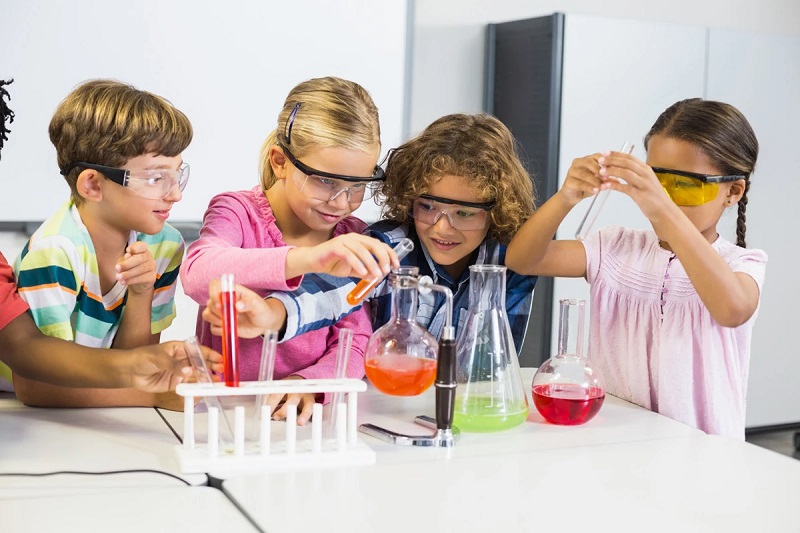
Tell a seven-year-old that warm air rises, and they might memorize the sentence long enough to repeat it on a quiz. Hand that same child a tissue-paper hot air balloon, hold a hair dryer underneath it, and let them feel the sudden lift against their fingertips, and the concept of thermal buoyancy becomes permanently etched in their mind.
Children are naturally wired to investigate the world through direct sensory feedback. Long before they learn to parse textbooks or decipher diagrams, they drop toys from high chairs to test gravity, splash in puddles to study displacement, and smash rocks together to discover what breaks. Yet traditional schooling often channels this innate investigative drive into passive memorization, reducing the thrill of scientific discovery to glossy textbook pages and standardized worksheets.
Introducing intentional, hands-on science experiments early in childhood bridges the gap between passive observation and active comprehension. Physical experimentation transforms scientific principles from distant, intimidating abstractions into vivid, everyday reality, building cognitive foundations that last long after the mess is wiped away.
Transforming Abstract Concepts into Tangible Reality
Young minds think in concrete terms. Developmental psychology has long demonstrated that young children process their surroundings primarily through tactile manipulation and direct cause-and-effect relationships. When complex ideas like chemical reactions, density, or electrical currents are presented purely through words or two-dimensional illustrations, children often struggle to construct an accurate mental model.
Physical experiments provide the sensory scaffolding required to anchor these concepts. When a child layers honey, dish soap, water, and vegetable oil into a clear glass, density stops being an equation involving mass divided by volume. It becomes a colorful, physical stack of fluids that refuse to mix. When they feel the cold drop in temperature after mixing baking soda and citric acid, endothermic energy transfer is no longer an invisible definition—it is a physical sensation cooling their palms.
This tactile engagement creates multimodal memory pathways. A child who physically manipulates variables retains the core principles far longer and with far greater fidelity than one who merely reads about an outcome or watches a video demonstration on a tablet screen.
Reframing Failure as Discovery and Iteration
One of the most profound lessons science teaches has nothing to do with test scores and everything to do with emotional resilience: an unexpected result is not a failure; it is data.
In many academic disciplines, tasks are designed around binary outcomes. A math problem is either right or wrong; a spelling test is either accurate or flawed. This dynamic often conditions young learners to fear making mistakes, leading to hesitation and risk aversion. Science experiments operate under an entirely different philosophy. When a paper airplane nosedives into the carpet or a homemade baking powder volcano produces a disappointing fizz instead of an eruption, the project has not failed. It has simply revealed a variable that demands adjustment.
Working through these moments teaches children the basics of the scientific method through organic trial and error:
-
What happens if we fold the wings up slightly instead of down?
-
Did we add too much water, diluting the active ingredients?
-
Does changing the angle of our cardboard ramp make the marble travel faster or fly off course?
By learning to diagnose why an experiment did not yield the anticipated result, children develop genuine problem-solving stamina. They stop viewing a misstep as a personal shortcoming and begin approaching surprises with calm curiosity and an urge to troubleshoot.
Cultivating Critical Inquiry and Active Observation
Left unchallenged, young minds quickly learn to ask passive questions aimed at finding quick answers: “What is this called?” or “What does this button do?” Hands-on experimentation shifts this dynamic from passive information retrieval to active inquiry.
When children are placed in the role of the experimenter, they learn to pay close attention to nuances that normally fade into the background. They notice the tiny air bubbles gathering on the side of a submerged leaf, the subtle change in surface tension when dish soap touches milk, or the way a shadow elongates as a flashlight moves lower.
This heightened awareness leads to higher-order questions:
-
Why did the red liquid move faster through the paper towel than the blue one?
-
Does the shape of the boat hull change how many pennies it can carry before sinking?
-
Why does the lightbulb turn on with copper wire but stay dark when we use plastic string?
Cultivating this mindset turns children from passive consumers of facts into active interrogators of their environment. They stop accepting surface-level explanations and begin looking for the underlying mechanisms that govern how things work, a mental habit that pays dividends across literacy, mathematics, and everyday decision-making.
Building Fine Motor Control and Multidisciplinary Competence
While the intellectual benefits of science experiments are clear, the physical and cross-disciplinary advantages are just as significant.
Handling science equipment requires delicate physical control. Squeezing an eyedropper to transfer liquid drop by drop, using tweezers to examine a plant specimen, balancing weights on a beam, or pouring liquids without spilling challenges and refines a child’s fine motor skills and hand-eye coordination. These precise mechanical movements build the same finger strength and dexterity that support neat handwriting, musical instrument practice, and artistic technique.
Furthermore, authentic experiments dissolve the artificial boundaries between school subjects:
Practical Mathematics
Measuring water in graduated cylinders, timing how long an ice cube takes to melt under different conditions, and charting results on a simple bar graph ground arithmetic in tangible goals. Children quickly realize that accurate measurements matter because precision changes the physical outcome.
Language and Descriptive Vocabulary
Describing an experiment demands precise expressive language. Children naturally expand their vocabulary to explain whether a mixture is viscous, translucent, effervescent, or brittle. Formulating a hypothesis encourages the use of conditional sentence structures, while summarizing findings sharpens sequential storytelling and clear communication.
Creating Meaningful Engagement Without Expensive Equipment
A common misconception among parents and educators is that valuable science experiments require specialized laboratory glassware, expensive kits, or complex chemicals. In practice, some of the most intellectually stimulating experiments rely on items already sitting in kitchen cupboards and recycling bins.
A stalk of celery sitting in colored water illustrates capillary action and plant vascular systems better than any textbook diagram. A piece of wool rubbed against a balloon demonstrates static electricity and electrostatic charge instantly. Constructing a simple marble run out of cardboard toilet paper tubes teaches gravity, friction, potential energy, and structural engineering in an afternoon.
The secret does not lie in the sophistication of the materials, but in how the activity is framed. Adults should resist the urge to turn kitchen experiments into rigid, scripted demonstrations where the grown-up does all the pouring while the child watches quietly. The true value emerges when the child handles the materials, drives the hypothesis, and controls the mess.
Encouraging children to get their hands dirty with physical experiments does more than prepare them for future STEM classes. It nurtures an enduring sense of agency and wonder. When a child realizes they have the tools to ask a question, test it with their own hands, and uncover the answer for themselves, they stop viewing the world as an arbitrary collection of rules and begin seeing it as an open landscape waiting to be explored.

Comments are closed.